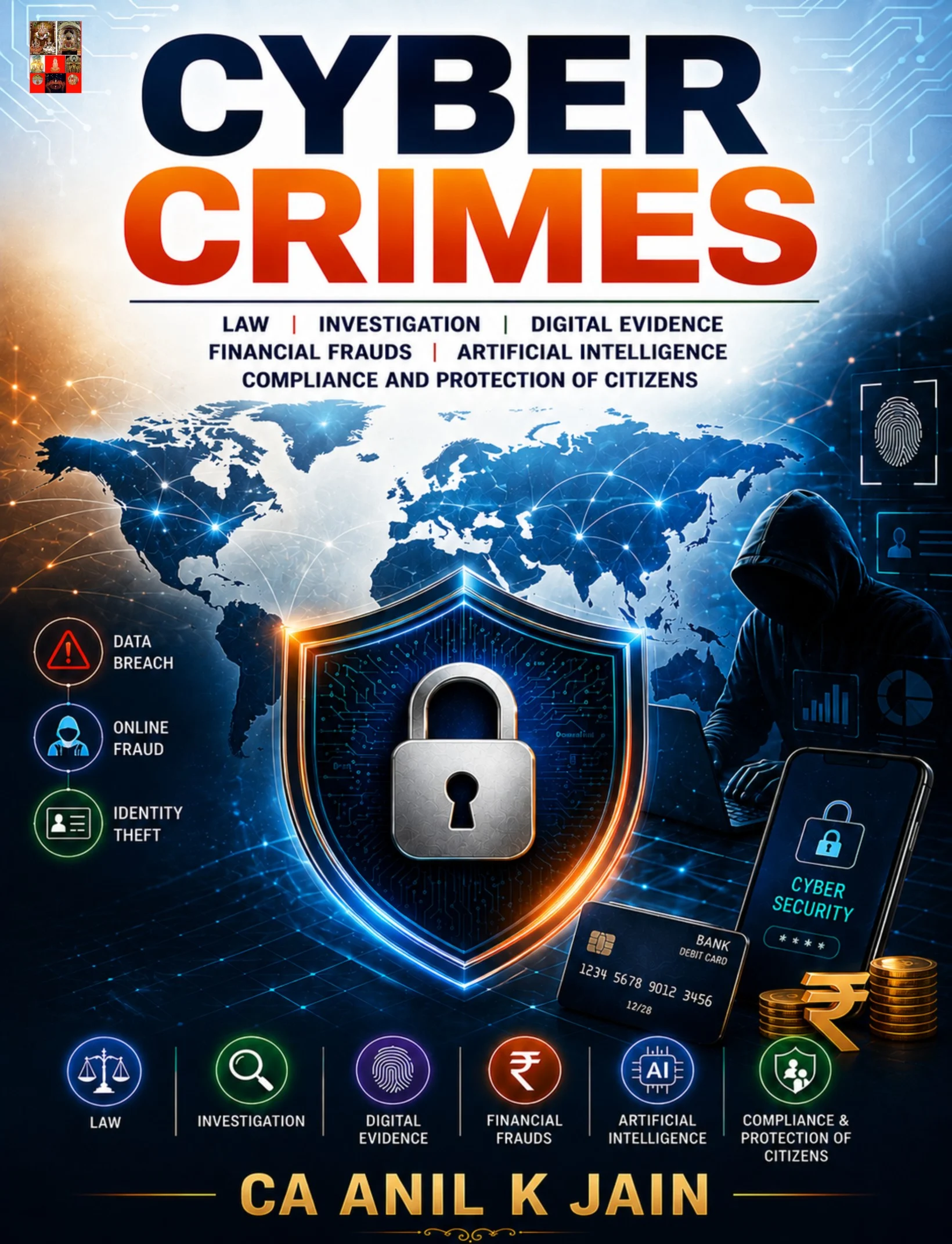
Cyber Crimes: Law, Investigation, Digital Evidence, Financial Frauds, Artificial Intelligence, Compliance and Protection of Citizens
Author: CA Anil K. Jain
Published by: Ahimsa Foundation
Chapters: 52
Home › Books › Cyber Crimes
Author: CA Anil K. Jain
Published by: Ahimsa Foundation
Chapters: 52
India's digital transformation has brought online banking, UPI payments, e-commerce and AI into daily life, and with them a sharp rise in cyber crime. Cyber Crimes is a comprehensive and practical guide to understanding how cyber crime works, how the law deals with it, and how individuals, businesses and institutions can protect themselves.
The book covers the full range of cyber offences: hacking, phishing, ransomware, identity theft, financial frauds, cyber stalking, cyber bullying, sextortion, deepfakes, corporate espionage, cyber terrorism and attacks on critical infrastructure. It also explains the legal framework, including the Information Technology Act 2000, the Bharatiya Nyaya Sanhita, the Bharatiya Nagarik Suraksha Sanhita, the Bharatiya Sakshya Adhiniyam and the Digital Personal Data Protection Act 2023, with landmark judgments, real cases and practical checklists.


Law students, advocates, judges, police officers, cyber crime investigators, forensic professionals, chartered accountants, company executives, compliance officers, bankers, IT and cyber security professionals, researchers, policymakers, educators, and every citizen who uses the internet and digital payments.



CA Anil Kumar Jain is a Chartered Accountant, economist, author and public policy researcher with over four decades of experience. He qualified as a CA in 1982 and has practised in New Delhi since 1984. He has submitted policy papers to the Government of India on taxation, financial regulation, digital governance and judicial reforms, and his recent work focuses on cyber law, cyber crime, AI, digital evidence and cyber security.
His other books: Bharat: The Development Dilemma and River Water Recharge Wells.
It explains cyber crime in India from legal, technical, investigative and policy angles, including laws, digital evidence, financial frauds, AI-enabled attacks and practical protection for citizens.
Yes. It has dedicated chapters on UPI frauds, banking frauds, income tax and GST related cyber frauds, corporate frauds and cryptocurrency frauds.
The book has a full chapter on this, plus a chapter on filing cyber crime complaints and the investigation agencies in India.
CA Anil K. Jain, a Chartered Accountant with more than 40 years of experience and a regular voice on television and radio on economic and cyber issues.
You can order online at indiafuture.jainsamaj.org.
© Ahimsa Foundation, Jodhpur, Rajasthan, India