


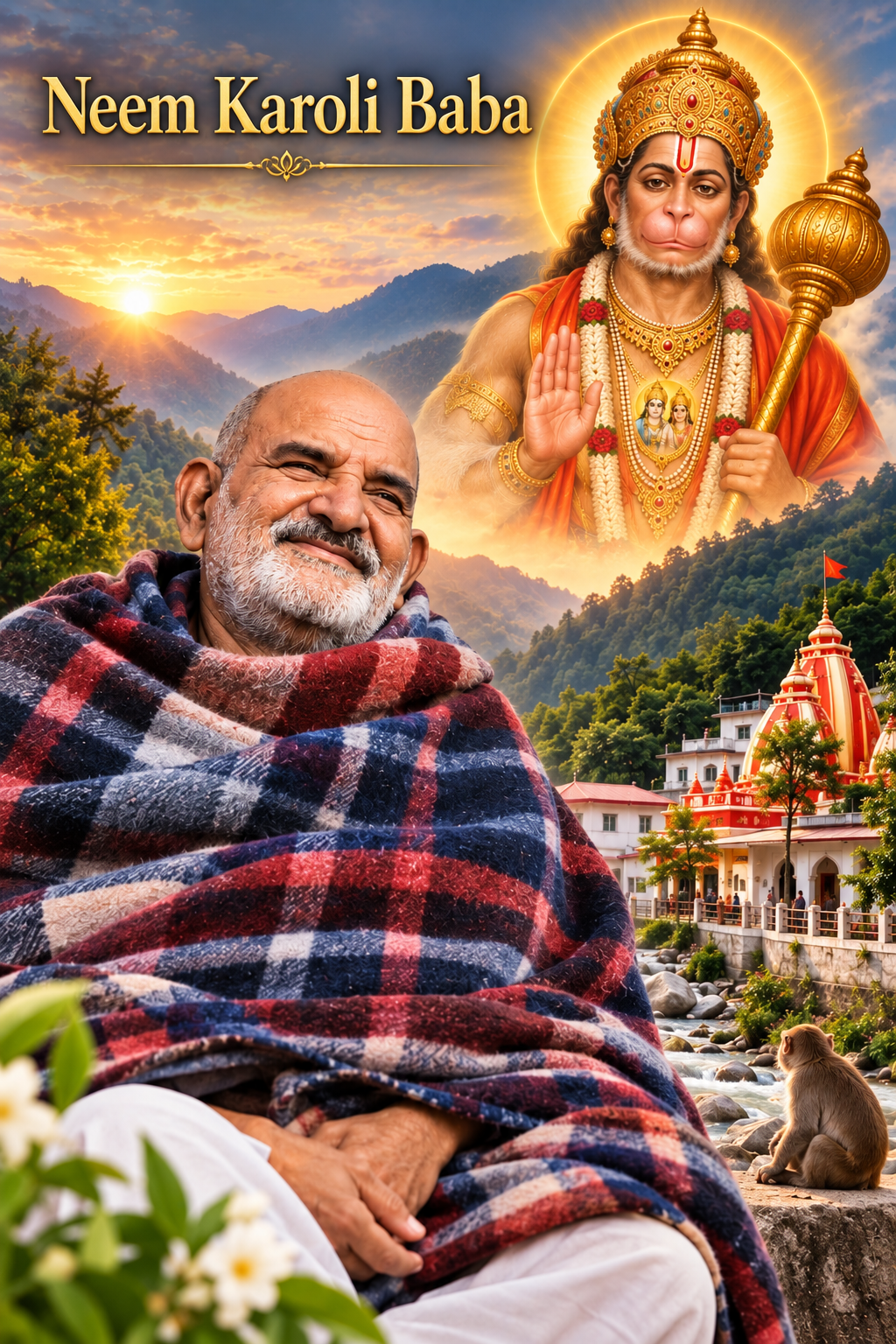
NEEM KAROLI BABA
President – Ahimsa Foundation India : Email: CAINDIA@HOTMAIL.COM
The Life, Teachings and Enduring Legacy of Maharaj-ji
Neem Karoli Baba—also written
as Neeb Karori Baba and affectionately called Maharaj-ji by his followers—was
one of the most influential Indian spiritual teachers of the twentieth century.
A deeply devoted follower of Lord Hanuman, he became known for a remarkably
simple spiritual message centred on love, devotion to God, compassion, feeding
people and selfless service.
Although he died in 1973, his
influence has continued to expand. His ashrams attract large numbers of
devotees, while his teachings have travelled far beyond India through disciples
such as Ram Dass. His name has also become associated with prominent
international figures including Steve Jobs and Mark Zuckerberg, while Indian
public figures such as Virat Kohli and Anushka Sharma have visited sites
associated with him. The extraordinary success of the 2026 film Hanuman Ansh,
inspired by his life, has introduced Maharaj-ji to another generation. It is
more accurate to say that Neem Karoli Baba is revered by a very large community
of devotees in India and abroad, rather than that he is worshipped by all
Indians. For devotees, however, Maharaj-ji is much more than a historical
religious teacher: many regard him as a saint, siddha or divinely realised
being.
EARLY LIFE
The precise details of Neem
Karoli Baba's early years are not completely certain, and different devotional
biographies sometimes give different versions. He is generally believed to have
been born around 1900 in Uttar Pradesh. His birth name is usually given as Lakshman
Narayan Sharma (with variations in spelling in different accounts). He was born
into a Brahmin family and was married at a young age, as was customary in many
parts of India at that time. Accounts of his life describe an early attraction
towards spirituality and renunciation. He left home for periods of wandering
and spiritual practice. Eventually, at his father's request, he returned to
family life. He became the father of two sons and a daughter,
demonstrating an unusual combination of the roles of householder and wandering
holy man. Over the years he travelled widely across northern India and became
known by several names.
HOW HE BECAME "NEEM KAROLI BABA"
One of the most famous stories
concerning Maharaj-ji explains the origin of the name by which the world
eventually knew him. According to the traditional account, he was once
travelling on a train without a ticket and was ordered to get off near the
village of Neeb Karori/Neem Karoli in Uttar Pradesh. After he left the train,
the locomotive supposedly would not move despite repeated attempts. The story
says that railway officials eventually requested the sadhu to return to the
train. He agreed, reportedly on conditions that included treating holy men
respectfully and establishing a railway stop for local people. According to
devotees' accounts, once he reboarded, the train started moving again. This
incident became one of the most frequently repeated stories associated with him
and helped establish the name Neem Karoli Baba. It is important, however, to
distinguish devotional tradition from independently verifiable history. The
train episode and many similar stories are central to the oral tradition
surrounding Maharaj-ji, but should not automatically be treated as
scientifically or historically established miracles. The new film Hanuman
Ansh also incorporates the famous train story into its depiction of his
life.
DEVOTION TO LORD HANUMAN
At the centre of Neem Karoli
Baba's spiritual life was an intense devotion to Lord Hanuman, the great
devotee of Lord Rama in the Ramayana. Hanuman represents strength, humility,
courage, absolute devotion and selfless service. These qualities are also
central to the way Maharaj-ji's followers understand his teachings. He
encouraged devotion to God, remembrance of the divine name and service to human
beings. Temples dedicated to Hanuman became closely associated with the ashrams
established around him. Rather than developing a complicated new religious
philosophy, Maharaj-ji emphasised direct spiritual practice and compassionate
living. His teachings are frequently summarised through the ideas: Love
everyone. Serve everyone. Feed people. Remember God.This simplicity became one
of the reasons his teachings could appeal to people from very different
cultural and religious backgrounds.
MAHARAJ-JI'S STYLE OF TEACHING
Neem Karoli Baba was very
different from a conventional religious lecturer. He did not become famous for
lengthy philosophical discourses or for establishing an elaborate theological
system. Much of what is known about his teachings comes instead from the
recollections of people who spent time with him. His approach emphasised bhakti—devotion
and love of God. For him, spirituality was closely connected with practical
compassion. Feeding a hungry person, serving someone in difficulty, remembering
God and treating other people with love could themselves become forms of
spiritual practice. His followers also remember him as someone who discouraged
excessive attachment to his own personality. Despite the enormous devotional
following that eventually grew around him, the image preserved by disciples is
of a guru who preferred simplicity and avoided elaborate self-promotion.
KAINCHI DHAM
The place most strongly
associated with Neem Karoli Baba today is Kainchi Dham, situated in the Kumaon
hills of Uttarakhand near Nainital. The ashram was established in 1964 and
became one of the principal centres connected with Maharaj-ji. Surrounded by
mountains and forest, Kainchi Dham developed into an important spiritual
destination. The complex contains temples associated with Hanuman and
Maharaj-ji and continues to receive devotees from India and overseas. Its
annual celebrations attract large crowds, and the remarkable international
reputation of the ashram is partly connected to the Western disciples and
visitors influenced by Maharaj-ji. The success of Hanuman Ansh in 2026
has created renewed public interest in Maharaj-ji and places associated with
his life. Recent reporting has described another surge of visitors seeking
locations connected with him.
RAM DASS AND THE SPREAD OF MAHARAJ-JI'S TEACHINGS IN THE
WEST
Perhaps no individual did more
to introduce Neem Karoli Baba to Western audiences than Ram Dass, originally
known as Dr Richard Alpert. Alpert had been a Harvard psychologist and was closely
associated with Timothy Leary and the psychedelic experimentation of the 1960s.
He travelled to India in 1967, where he encountered Neem Karoli Baba.
Maharaj-ji gave him the name Ram Dass, meaning "servant of God." The
encounter fundamentally changed the direction of his life. Ram Dass
subsequently became an influential spiritual teacher in the United States. His
landmark 1971 book Be Here Now introduced large numbers of Western readers to
Indian spirituality and helped spread awareness of Neem Karoli Baba. Through
Ram Dass and other disciples, a spiritual teacher who himself never became an
international travelling guru acquired an extraordinary international
following.
MIRACLES AND STORIES ASSOCIATED WITH MAHARAJ-JI
An important part of Neem
Karoli Baba's reputation concerns the many extraordinary experiences reported
by his devotees. Followers have attributed to him abilities such as apparently
knowing people's thoughts or circumstances without being told, appearing to
possess knowledge of distant events, healing or helping people during crises,
producing unexpectedly large quantities of food, and influencing circumstances
in ways devotees regarded as miraculous. The railway story is perhaps the most
famous example. For believers, these accounts demonstrate Maharaj-ji's
spiritual attainment. From a historical or scientific perspective, however,
many such stories cannot be independently verified and largely come from disciples,
eyewitness recollections and devotional literature.
This distinction is important.
One can understand the importance of the miracle tradition to Neem Karoli
Baba's followers without presenting every supernatural claim as an
independently established fact. Maharaj-ji's deeper legacy arguably rests less
on miracle stories than on the values repeatedly associated with him: love,
seva, compassion, devotion and feeding those in need.
HIS INTERNATIONAL AND CELEBRITY FOLLOWING
One of the most fascinating as
pects of Neem Karoli Baba's legacy is the influence associated with him among
prominent Western spiritual seekers, entrepreneurs, artists and
philanthropists.
Ram Dass -Ram Dass
actually met Neem Karoli Baba and became his disciple. His writings and
lectures were crucial in carrying Maharaj-ji's teachings to the Western world.
Steve Jobs- The
connection with Apple co-founder Steve Jobs needs an important clarification. Jobs
travelled to India in 1974, seeking spiritual understanding and hoping to
encounter Neem Karoli Baba. However, Maharaj-ji had already died in September
1973. Jobs therefore did not personally meet Neem Karoli Baba. Jobs
nevertheless travelled to the Kainchi region and spent time exploring Indian
spirituality. His travelling companion Daniel Kottke later recalled arriving at
the Neem Karoli ashram after Maharaj-ji's death and finding it largely
deserted. Thus, statements sometimes circulated online that Jobs personally
received Neem Karoli Baba's blessings should be treated cautiously. The
documented connection is that Jobs travelled to India seeking him and
encountered the spiritual environment associated with him after his death.
Mark
Zuckerberg -The connection later extended to Facebook co-founder Mark
Zuckerberg. Zuckerberg has spoken publicly about travelling in India during a
difficult period in Facebook's early history. According to accounts of the
episode, Steve Jobs encouraged him to visit the temple associated with the
spiritual tradition that Jobs himself had encountered in India. Zuckerberg
subsequently visited Kainchi Dham. This created an extraordinary symbolic link
between a relatively secluded Himalayan spiritual centre and two generations of
Silicon Valley entrepreneurs.
Julia
Roberts -Hollywood actress Julia Roberts has also been associated
with Neem Karoli Baba's influence. Reports about her spiritual journey have
linked her interest in Hinduism to encountering an image of Maharaj-ji. Some
popular accounts go further and claim repeated visits to Kainchi Dham, although
the details are less firmly documented than the Ram Dass connection and should
therefore be stated with appropriate caution.
Larry
Brilliant -Another significant follower was American physician and
public-health figure Dr Larry Brilliant. Brilliant spent time with Maharaj-ji
and later became deeply involved in international efforts against smallpox.
Accounts from Brilliant's life describe Maharaj-ji encouraging him to become
involved with the international smallpox-eradication effort. His story is
especially interesting because it connects Maharaj-ji's idea of seva—service—to
practical humanitarian work.
Virat Kohli
and Anushka Sharma -In recent years, Indian cricketer Virat Kohli and actor Anushka
Sharma have also been prominently associated in media reports with visits to
places connected with Neem Karoli Baba. Their visits contributed to renewed
interest in Maharaj-ji among younger Indians, although visiting an ashram
should not automatically be interpreted as formal discipleship. Other prominent
Western visitors and admirers have also been linked with the wider Neem Karoli
Baba spiritual tradition. Reporting on Kainchi Dham has noted its unusual
attraction for members of the American technology community.
DEATH OF NEEM KAROLI BABA
Neem Karoli Baba died on 11
September 1973 in Vrindavan. Accounts state that he had experienced health
problems and was taken to a hospital in Vrindavan, where he died during the
early hours of 11 September. For devotees, his physical death did not represent
the end of his spiritual presence. His temples, ashrams and communities
continued functioning, while the books and memories of disciples introduced him
to people who had never met him during his lifetime. In that sense, his
international reputation actually expanded considerably after his death.
HANUMAN ANSH: THE
2026 FILM INSPIRED BY NEEM KAROLI BABA
The extraordinary revival of
interest in Maharaj-ji in 2026 is closely connected with the Hindi devotional
film Hanuman Ansh. Directed and written by Vishal Chaturvedi, the film was
released in cinemas on 7 August 2026. It dramatises the spiritual journey of
Neem Karoli Baba, beginning with his earlier life and moving towards his
emergence as the spiritual figure remembered as Maharaj-ji. The film features Shobinaw
Satyaa in the central role associated with Neem Karoli Baba, with Chandan Anand
and an ensemble cast including Nikhil Dubey, Udaysinh Rajput, Purnima Tiwari
and Mannish Chaudhary. The production itself had an unusual history. Director
Vishal Chaturvedi has said that the project represented many years of work and
research. Shobinaw Satyaa was originally working on the production as an
assistant director before circumstances led to him auditioning for the role of
Maharaj-ji. According to his account, the transition from crew member to
leading actor happened remarkably quickly. The filmmakers also faced
considerable difficulties getting the project completed and distributed. Recent
interviews describe financial problems, changes to the production team and
rejection by an OTT platform before the film eventually reached cinemas.
An
Unexpected Blockbuster
Hanuman Ansh began as a
comparatively small production without the marketing machinery or star cast
normally associated with a major Hindi blockbuster. Its performance then
changed dramatically through word of mouth. By 19 September 2026, contemporary reporting described
the film as having crossed approximately ₹300 crore worldwide, although
different trade reports and publications have quoted somewhat different figures
as its theatrical run has continued. That is particularly remarkable because
contemporary reports place its production budget at only around ₹1.7–2 crore. The
film therefore became one of 2026's most surprising Indian
box-office stories. Its success is significant beyond cinema. It has introduced
Neem Karoli Baba's life to audiences who may previously have known him only
from social media photographs, stories about Steve Jobs, or references to Kainchi
Dham. Some screenings have reportedly taken on an atmosphere resembling
devotional gatherings, demonstrating how the boundary between religious
experience and cinematic experience can become blurred when a film concerns a
revered spiritual figure. The film should nevertheless be understood as a devotional
cinematic interpretation inspired by Maharaj-ji's life, rather than as a
documentary in which every scene should automatically be regarded as
historically verified.
CONTROVERSIES AND QUESTIONS SURROUNDING NEEM KAROLI BABA
Compared with many modern
religious personalities, Neem Karoli Baba himself is not associated in credible
mainstream reporting with a major, well-established personal scandal.There are,
however, several areas where controversy, disagreement or caution is
appropriate.
1. Miracles
versus Historical Evidence
Many of the most famous
stories about Maharaj-ji—including the railway incident and accounts of
supernatural knowledge—come from devotees and oral traditions. Followers regard
them as evidence of divine grace or spiritual powers. A historical or secular
examination must distinguish these accounts from events supported by
independent contemporary documentation. This does not mean that the stories are
meaningless. They are extremely important for understanding the faith
surrounding Maharaj-ji. It simply means that faith claims and historically
verifiable claims belong to different categories of evidence.
2.
Exaggerated Celebrity Connections
Modern social media sometimes
simplifies or exaggerates Maharaj-ji's relationships with famous people. Steve
Jobs is the clearest example. Jobs went to India hoping to find Neem Karoli
Baba, but Maharaj-ji had already died. Therefore, descriptions claiming that
Jobs personally met Maharaj-ji or directly received his advice before creating
Apple are inconsistent with the established chronology. Similarly, celebrity
visits to an ashram do not necessarily establish that the visitor became a
formal disciple.
3.
Commercialisation and Social-Media "Miracle" Culture
Maharaj-ji's enormous
contemporary popularity has produced a flood of online posts promising
prosperity, marriage, employment, healing or other rewards in exchange for
sharing his image or posting devotional phrases. This has itself attracted
criticism. A 2026 Hindustan Times commentary argued that such internet claims
risk turning genuine devotion into clickbait and presenting matters of faith as
guaranteed formulas for material results. This phenomenon is especially
noteworthy because the historical image of Maharaj-ji preserved by his followers
is one of simplicity and lack of interest in personal publicity.
4. Dispute
Concerning an Ancestral Property
A more concrete recent
controversy concerns property associated with Neem Karoli Baba's family. In August
2026, six granddaughters from his family approached the Firozabad district
administration regarding a dispute involving his ancestral home and a worship
site. They made allegations concerning interference by the Shri Thakur Hanuman
Ji Trust. The trust disputed the allegations, and authorities were examining
records and competing claims. This is important to describe accurately: it is a
property/trust dispute involving descendants and an organisation associated
with the site, not evidence of wrongdoing by Neem Karoli Baba himself, who died
more than five decades earlier.
5. The
Difficulty of Separating Biography from Hagiography
A broader scholarly challenge
is that much of what is popularly known about Maharaj-ji comes from disciples
and devotional literature. Such accounts provide invaluable insight into how
followers experienced him, but they naturally emphasise spiritual experiences
and miracles. Consequently, any responsible biography should distinguish among,
Documented biographical events; first-hand recollections of disciples; traditional
stories; and explicitly supernatural claims accepted through faith. Doing so
neither dismisses faith nor presents belief as historical proof.
WHY HIS MESSAGE CONTINUES TO ATTRACT PEOPLE
The enduring attraction of
Neem Karoli Baba may ultimately be explained by the extraordinary simplicity of
the spiritual ideal associated with him. His message did not require people to
master complicated theology. It asked them to love, serve, remember God and
care for other human beings. This allowed Maharaj-ji's teachings to cross
cultural boundaries. A Hindu devotee could understand his life through bhakti
and Hanuman. A Western spiritual seeker could encounter his teachings through
Ram Dass. A humanitarian such as Larry Brilliant could interpret seva through
public service. Modern visitors may simply experience Kainchi Dham as a place
for contemplation and inner quiet. His influence therefore extends beyond any
single category of religion, celebrity culture or popular spirituality.
NEEM KAROLI BABA AND MODERN INDIA
The extraordinary success of Hanuman
Ansh demonstrates that Neem Karoli Baba is no longer merely a figure
remembered by an older generation of devotees. More than fifty years after his
death, he has acquired a substantial new audience. Social media, celebrity
visits, international interest in Kainchi Dham and now cinema have transformed
the scale of public attention surrounding him. The result is a fascinating
combination of traditional Hindu bhakti and twenty-first-century global popular
culture. At the same time, this popularity creates a responsibility to
distinguish Maharaj-ji's documented teachings from commercial claims and
internet mythology made in his name.
CONCLUSION
Neem Karoli Baba occupies an
unusual place in modern Indian spiritual history. Born as Lakshman Narayan
Sharma around the beginning of the twentieth century, he lived without building
the kind of international organisation normally associated with globally famous
gurus. He remained deeply connected with Hanuman bhakti, simplicity, service
and personal encounters with devotees. Yet his influence travelled remarkably
far. Ram Dass carried his memory into Western spiritual culture. Steve Jobs
travelled to India seeking the guru, although he arrived after Maharaj-ji's
death. Mark Zuckerberg later visited Kainchi Dham. Larry Brilliant connected
his spiritual experience with a life of public service. Actors, athletes,
entrepreneurs and ordinary pilgrims have continued to visit places associated
with him.
Then, more than half a century
after Maharaj-ji's death, Hanuman Ansh unexpectedly transformed his life
into one of India's major cinematic stories of 2026. The small-budget
devotional film grew through word of mouth into a blockbuster and created
another wave of interest in his life and teachings. There are miraculous
stories surrounding him that belong principally to the realm of devotion rather
than independently verified history. There are also modern disputes over
property associated with his legacy and legitimate concerns about social-media
exaggeration and commercialisation. But these controversies have so far
remained largely around his legacy rather than constituting a documented major
personal scandal involving Maharaj-ji himself. Perhaps the most enduring
explanation for his appeal is also the simplest. Behind the miracles, famous
followers, pilgrimage centres and now a blockbuster film lies a message that
requires very little explanation:
Love people. Serve people. Feed
people. Remember God.
For millions of devotees, that
remains the essence of Neem Karoli Baba—Maharaj-ji—and the reason his influence
continues to grow long after his physical life ended. I deliberately corrected
a few widely repeated claims—especially the idea that Steve Jobs personally met
Neem Karoli Baba. Jobs reached India in 1974, whereas Maharaj-ji died on 11
September 1973. That distinction will make the note more credible if you intend
to publish it.
Mail to : Ahimsa Foundation
www.jainsamaj.org
R190926
Ahimsa Foundation warmly welcomes information, photographs, literature, articles, and other meaningful contributions for publication on this web portal: www.jainsamaj.org | ✉ CAINDIA@HOTMAIL.COM
We also invite advertisements and sponsorship support to help us expand the reach of this social initiative and promote public awareness of Jain ideology.
 Related
 Related
 Related

Copyright © 2026 jainsamaj. All rights reserved.