


Acharya Dr. Shivmuniji M. S.
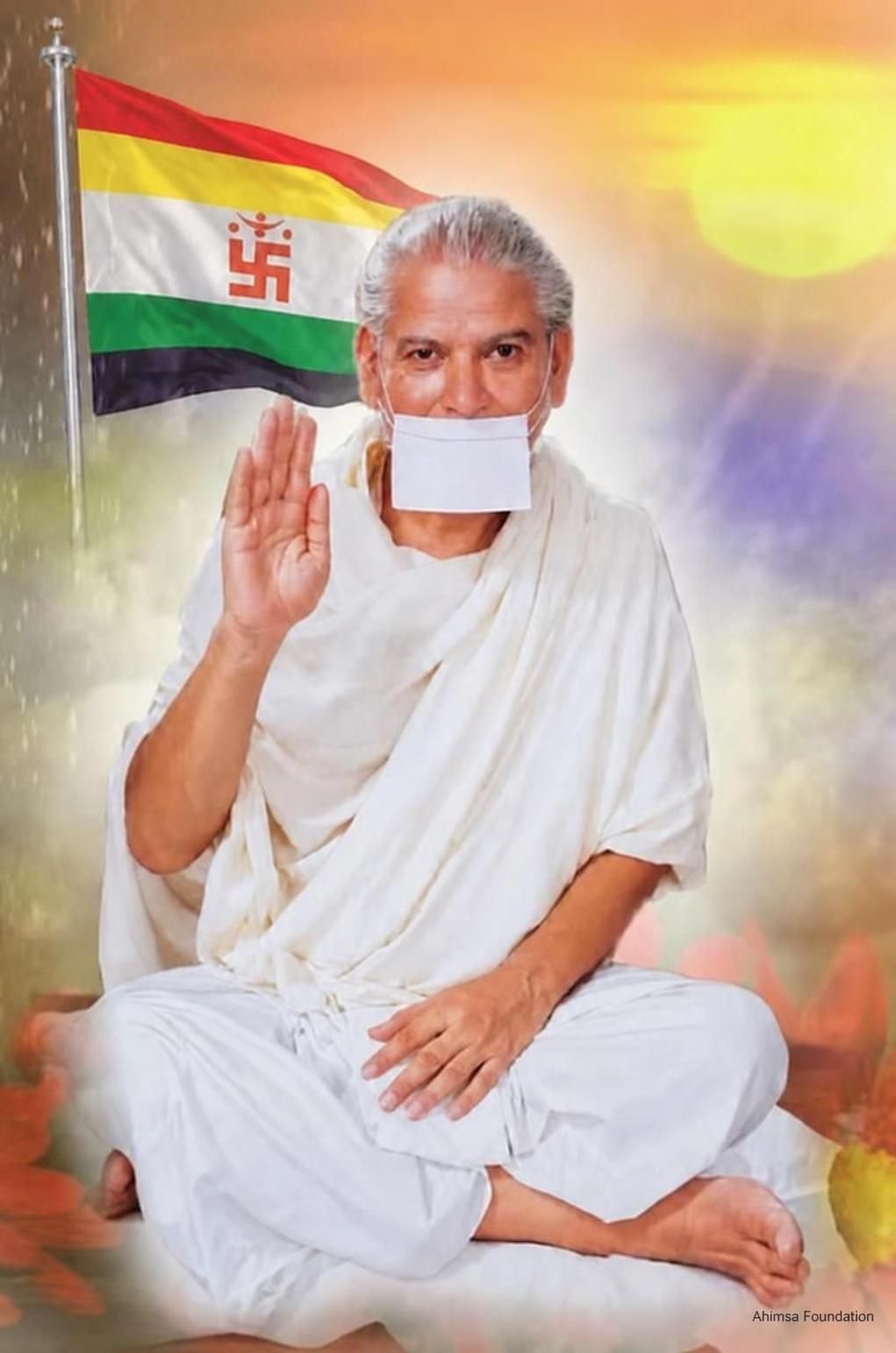
Acharya Samrat Dr. Shri Shiv Muni Ji Maharaj Saheb was born on 18 September 1942 into an Oswal Jain family. His father was Shri Chiranji Lal Jain and his mother was Smt. Vidya Devi Jain. The family was associated with Malout Mandi in the former Faridkot district of Punjab; some biographical accounts identify his birthplace more specifically as Rania Mandi in present-day Haryana. His childhood unfolded during a turbulent period in Indian history. A biographical account describes his exposure to communal violence and the suffering caused by conflict, experiences that helped shape his commitment to non-violence and peace.
Before entering monastic life, Shiv Kumar pursued higher education. His recorded qualifications include a master's degree in Philosophy, a master's degree in English Literature, a PhD and a D.Litt. His doctoral research concerned the concept of liberation, or moksha, in Indian religions, with particular reference to Jainism. He also travelled abroad during his student years, visiting countries including the United States, Canada, England and Switzerland, according to biographical accounts. These experiences exposed him to different societies, religious traditions and approaches to ethics. His educational journey was unusual in that formal academic achievement did not end his search for meaning. Instead, the study of philosophy and religion deepened his interest in questions about the soul, suffering, consciousness and liberation.
A defining turning point came on 17 May 1972, when Shiv Kumar accepted Jain diksha at Malout Mandi, Punjab. His diksha guru was Pujya Shri Gyan Muniji Maharaj Saheb, a respected scholar of Jain scriptures and spiritual teacher. Following renunciation, he became known as Muni Shri Shiv Kumar, later widely revered as Acharya Dr. Shiv Muni Ji Maharaj Saheb. Diksha is a profound commitment in Jainism. It marks the renunciation of worldly ambitions and the acceptance of an ascetic life governed by spiritual discipline, self-restraint and non-violence. For a Jain monk, renunciation is not simply a change in outward circumstances. It is a sustained effort to overcome attachment, anger, pride, deceit and greed—the passions that Jain philosophy associates with the bondage of karma. Acharya Shri Shiv Muni Ji's subsequent emphasis on meditation and the realisation of the inner self became a defining feature of his spiritual teaching.
On 13 May 1987, Acharya Samrat Shri Anand Rishi Ji Maharaj Saheb appointed Shiv Muni Ji as Yuvacharya of the Shvetambar Sthanakwasi Shraman Sangh at a gathering in Pune, Maharashtra. Yuvacharya is a significant leadership designation in this monastic tradition. It recognises a monk entrusted with substantial spiritual and organisational responsibilities within the community. The appointment reflected his standing as a scholar and spiritual teacher, as well as the confidence placed in his ability to serve the wider Shraman Sangh.
Following the passing of Acharya Shri Devendra Muniji Maharaj Saheb in 1999, Shiv Muni Ji was appointed the fourth Pattadhar Acharya of the Shvetambar Sthanakwasi Shraman Sangh. His Acharya appointment took place on 9 June 1999 at Ahmednagar, Maharashtra. A separate Chadar Mahotsav, marking the formal ceremonial recognition of his leadership, was subsequently held at Rishabh Vihar in Delhi in May 2001; institutional accounts differ slightly on the precise ceremony date. As Acharya, he assumed responsibility for guiding the monastic community, encouraging religious education, supporting meditation and spiritual practice, and promoting Jain principles among the public. His leadership is associated with a particular emphasis on inner transformation and the practical application of Jain philosophy in contemporary life.
One of the central themes of Acharya Shri Shiv Muni Ji's spiritual teaching is Atma Dhyana—meditation directed towards understanding and experiencing the soul. Jain philosophy distinguishes the soul, or jiva, from material existence. Bondage arises through karma, while liberation involves the purification of the soul and freedom from karmic attachment. Meditation, self-restraint, right knowledge and right conduct are important elements of this spiritual path.
Acharya Shri Shiv Muni Ji has placed particular emphasis on meditation as a means of developing inner awareness, calmness and self-understanding. His teaching encourages practitioners to look beyond external distractions and examine their own thoughts, desires and reactions. His official website features programmes dedicated to Atma Dhyana and Shiv Dhyan Dhara. Meditation in this context is not merely a relaxation technique. It is presented as a spiritual discipline that encourages awareness of the self and a gradual reduction in attachment and passions. emphasis on meditation has helped bring questions of inner peace, ethical conduct and spiritual awareness into the public discussion of Jain religious practice.
Acharya Dr. Shiv Muni Ji has written on Jain philosophy, meditation, spirituality and the Jain understanding of liberation. The biographical sources list several of his books, including:
Dhyan Ek Divya Sadhana -A work devoted to meditation as a spiritual discipline and its place in the journey towards inner awareness.
The Jain Tradition - A book addressing the Jain religious and philosophical tradition for readers seeking an introduction to its teachings.
The Jaina Pathway to Liberation -A work concerned with the Jain understanding of liberation and the spiritual principles underlying the path to moksha.
Nadi Nav Sanjog -Also listed among his publications in the biographical record.
His academic background lends an analytical dimension to his religious work. His study of philosophy and liberation brings together questions traditionally explored through Jain scriptures and broader Indian philosophical thought.
Acharya Shri Shiv Muni Ji's work extends beyond religious discourses and personal spiritual practice. His biographies associate him with the establishment or promotion of institutions intended to support education, meditation and religious study.
Two initiatives particularly associated with his work are:
Bhagwan Mahavir Meditation and Research Centre, Delhi: Associated with meditation, spiritual development and research.
Shri Saraswati Vidya Kendra, Nashik: Associated with education and the development of learning among younger generations.
These initiatives reflect an approach that links spiritual development with education and organised community service. Education equips young people with knowledge and skills, while meditation and ethical reflection can encourage greater self-awareness and responsibility. Within Jain philosophy, these objectives complement the broader commitment to non-violence and the welfare of living beings. The precise founding dates, administrative structures and present operational status of the institutions should be checked with the institutions themselves for formal historical documentation.
Acharya Shri Shiv Muni Ji's public message has consistently been associated with non-violence, inner peace and spiritual harmony. His biography describes his commitment to addressing the suffering caused by communal conflict and to presenting non-violence as a principle relevant to humanity as a whole. The Jain principle of Ahimsa extends beyond avoiding physical injury. It also encourages restraint in speech, respect for different viewpoints and the reduction of hostility in human relationships. His public activities and institutional associations reflect an effort to make these principles relevant beyond the Jain community. Interfaith understanding, in this perspective, can develop when people learn to respect others without abandoning their own ethical commitments. The broader message is that peace begins with the discipline of the individual, but its benefits can extend to families, communities and society.
Several biographical sources record honours associated with Acharya Shri Shiv Muni Ji's religious and social work.
Recognition | Year or detail reported |
|---|---|
Mahatma Gandhi Service Award | 2006 |
Sai Mian Mir International Award | 2005, as reported by JainSamaj.org |
A. P. J. Abdul Kalam World Peace Award | 2020, as reported by JainSamaj.org |
Chief patron of Sarva Dharma Mahasangh | Recorded in institutional biographies |
These honours are reported in Jain community biographies. For a formal publication, the award-giving organisations' records should be consulted to confirm the official titles, dates and circumstances of each award.
The Shvetambar Sthanakwasi tradition is one of the major traditions within Shvetambar Jainism. Sthanakwasi followers generally worship in prayer halls known as sthanaks rather than practising idol worship, and place particular emphasis on scriptural teachings, meditation, ascetic discipline and ethical conduct. As the fourth Pattadhar Acharya of the Shraman Sangh, Acharya Shri Shiv Muni Ji occupies an important position in this institutional lineage.
His contribution combines several dimensions:
Spiritual leadership: Guiding monks, nuns and lay followers.
Meditation: Encouraging the practice of inner awareness and spiritual discipline.
Scholarship: Communicating Jain philosophical ideas through writing and teaching.
Education: Supporting initiatives for learning and personal development.
Peace and non-violence: Promoting ethical values relevant to society at large.
This combination of religious leadership, philosophical study and meditation forms the central theme of his public spiritual identity.
The life of Acharya Shri Shiv Muni Ji Maharaj Saheb illustrates several enduring Jain principles.
Self-realisation: Understanding oneself requires more than external knowledge; it also calls for introspection and disciplined awareness.
Non-violence: Peaceful conduct begins with respect for living beings and restraint in thought, word and action.
Non-possessiveness: Reducing attachment to possessions and status creates space for spiritual development.
Right knowledge: Learning is most valuable when it deepens understanding and improves conduct.
Equanimity: Meditation and self-discipline encourage a balanced response to difficulties, disagreements and changing circumstances.
These ideals are relevant to monks and householders alike. They offer a framework for living with greater compassion, responsibility and awareness.
Acharya Samrat Dr. Shri Shiv Muni Ji Maharaj Saheb is a prominent spiritual leader of the Shvetambar Sthanakwasi Jain Shraman Sangh. Born on 18 September 1942 into an Oswal Jain family, he pursued higher studies in philosophy and English literature before accepting diksha on 17 May 1972 under Shri Gyan Muniji Maharaj Saheb. He was appointed Yuvacharya in 1987 and became the fourth Pattadhar Acharya of the Shraman Sangh in 1999. His work brings together Jain scholarship, meditation, spiritual leadership, education and the promotion of non-violence. His emphasis on Atma Dhyana highlights the Jain understanding that lasting peace begins with the disciplined exploration of one's inner life. His journey also illustrates that formal education and spiritual inquiry need not be separate pursuits. Intellectual learning can deepen philosophical understanding, while meditation and ethical practice can give that understanding practical meaning. The central message associated with his spiritual teaching is that true progress begins with self-awareness, develops through restraint and compassion, and finds expression in peaceful conduct towards all living beings. May the teachings of Lord Mahavir continue to inspire humanity to follow the path of Ahimsa, truth, self-discipline, forgiveness and universal peace.

-----------------------------------------------------
Mail to : Ahimsa Foundation
www.jainsamaj.org
R271026
Ahimsa Foundation warmly welcomes information, photographs, literature, articles, and other meaningful contributions for publication on this web portal: www.jainsamaj.org | ✉ CAINDIA@HOTMAIL.COM
We also invite advertisements and sponsorship support to help us expand the reach of this social initiative and promote public awareness of Jain ideology.
 Related
 Related
 Related

Copyright © 2026 jainsamaj. All rights reserved.