


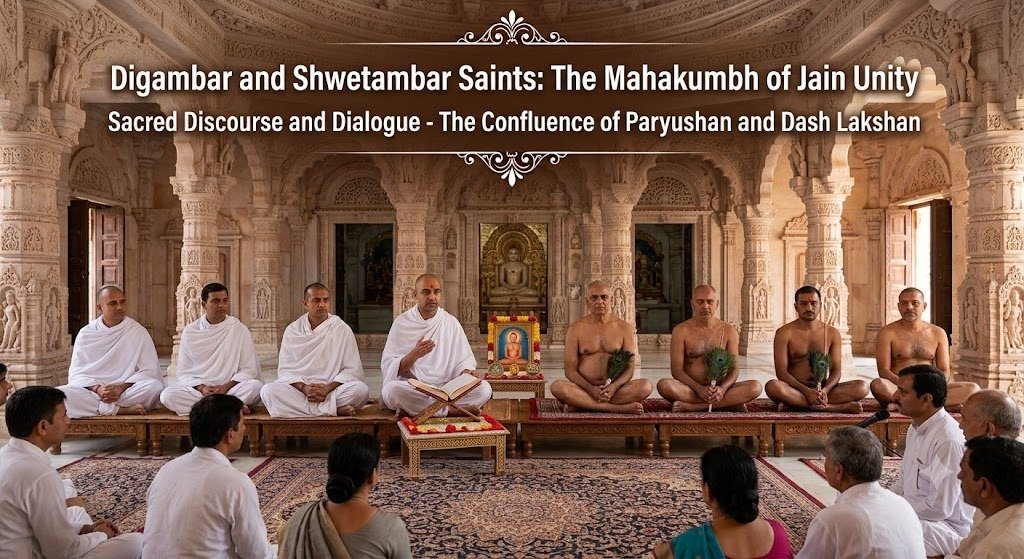
In the Jain tradition, two of the most significant and spiritually profound observances of the year are Paryushan Parva and Das Lakshana Parva. These festivals represent the pinnacle of the Jain religious calendar—a time when the community comes together for intensive spiritual practice, deep introspection, and the purification of the soul. Unlike worldly festivals associated with feasting and merrymaking, Paryushan and Das Lakshana are dedicated to spiritual upliftment, self-discipline, and the cultivation of inner virtues.
The term Paryushan literally means "abiding" or "coming together". It is an eternal festival that relates neither to any particular person nor to any historical event—it is a time to celebrate the natural qualities of the soul itself. The festival marks the closing of the Jain year, providing an opportunity for Jains to reflect on their actions over the past twelve months and seek purification before the new year begins.
Das Lakshana, meaning the "Festival of the Ten Religious Qualities," is observed as a celebration of ten universal virtues that are essential for spiritual progress. It is a period dedicated to the observance and veneration of these virtues in thought, speech, and action.
One of the key distinctions in Jain festival observance lies between the two major sects:
In North America and many other parts of the world, Jain communities often combine both observances into an 18-day period of celebration—eight days of Paryushan followed by ten days of Das Lakshana.
The festival takes place in the month of Bhadrapada (August–September), during the monsoon season. This is historically significant because it is the time when Jain monks and nuns cease traveling and remain in one place to avoid harming small insects and living beings that emerge during the rains. The presence of monastic leaders in the community during this period allows the laity to receive instruction and guidance.
For those planning to observe these festivals, the dates for 2026 are:
Fasting is one of the central practices during Paryushan and Das Lakshana. The duration and intensity of fasting vary according to individual capacity and devotion:
In the Śvetāmbara tradition, those observing a fast consume only boiled water between sunrise and sunset. The boiling of water is essential to avoid harming microorganisms. Some devoted individuals undertake fasts lasting up to 30 days or even longer.
Even those who do not fast adopt a highly restricted diet during this period. Jains, who already follow a strict vegetarian diet, add further restrictions:
Pratikraman is perhaps the most significant ritual of Paryushan. It is a practice of confession and repentance, a time for introspection and self-reflection.
During Paryushan, Pratikraman is performed twice daily—in the morning and evening—making a total of 17 times over the eight-day period. The practice involves:
The Samvatsari Pratikraman is the most important of all Pratikraman rituals, performed on the final day of Paryushan. This is the "Annual Confession" where every member of the community:
On this day, the Barasa Sutra is read in the morning, followed by the Samvatsarik Pratikraman in the evening.
Following the Samvatsari Pratikraman, Jains exchange the phrase "Michchhami Dukkadam" (or "Uttam Kshama"), which means: "If I have offended you in any way, knowingly or unknowingly, in thought, word, or action, then I seek your forgiveness".
This is not merely a ritual utterance but a profound act of humility and reconciliation. Jains first forgive others and then ask for forgiveness. This practice extends beyond the community to include friends, co-workers, and even enemies.
During Paryushan, the Kalpa Sutra—one of the most important Jain scriptures—is read publicly. This sacred text recounts:
The reading typically begins on the fourth day of Paryushan. The scripture, usually housed in monastery libraries, is taken out in a ceremonial procession and read by monks before the laity. The recitation is accompanied by the display and veneration of miniature paintings illustrating the incidents described.
In the Digambara tradition, during Das Lakshana, the ten chapters of the Tattvartha Sutra—the foundational Jain philosophical text—are recited, one chapter each day. Each day focuses on one of the ten virtues described in the scripture.
Chaitya Pari Paati—visiting local Jain temples—is an important aspect of the festival. Temples are beautifully decorated, and images of the Tirthankaras are the focus of devotion.
On the fourth day of Paryushan, which coincides with the birth anniversary of Mahavira, special celebrations are held. The fifth day is observed as Mahavir Janma Vanchan with great vigor.
On the final day of Paryushan (Samvatsari), Jains distribute alms to the poor and take out a procession of the Jina (savior) image, headed by an ornamental pole called Indra-dhvaja ("Staff of Indra").
The Ten Virtues of Das Lakshana
Each day of Das Lakshana is dedicated to the contemplation and practice of
one of the ten supreme virtues (Uttama Dharmas):
|
Day |
Virtue (Sanskrit) |
Meaning |
|
1 |
Uttam Kshama |
Supreme Forgiveness / Forbearance |
|
2 |
Uttam Mardava |
Supreme Modesty / Humility |
|
3 |
Uttam Arjava |
Supreme Straightforwardness / Honesty |
|
4 |
Uttam Shaucha |
Supreme Purity / Contentment |
|
5 |
Uttam Satya |
Supreme Truthfulness |
|
6 |
Uttam Sanyam |
Supreme Self-Restraint |
|
7 |
Uttam Tapa |
Supreme Penance / Austerity |
|
8 |
Uttam Tyaga |
Supreme Renunciation |
|
9 |
Uttam Akinchanya |
Supreme Non-Attachment |
|
10 |
Uttam Brahmacharya |
Supreme Celibacy / Chastity |
Each virtue is understood not merely as the absence of its opposite vice but as the active expression of the soul's true nature. The first virtue, Uttam Kshama (forbearance), is considered the ornament of the brave—"Kshamaa Virashya Bhushanam". Lord Mahavira and Lord Parshvanatha are held as shining examples of supreme forbearance against intense adversity.
Samayik—a state of total equanimity—is practiced daily during both Paryushan and Das Lakshana. This involves withdrawing from worldly attachments and focusing on the soul's true nature.
The sixth day of Das Lakshana is celebrated as Sugandh Dashami in the Digambara tradition.
Das Lakshana concludes on Ananta Chaturdashi, the fourteenth day of the bright fortnight, which marks the day when Lord Vasupujya, the 12th Jain Tirthankara, attained Moksha (liberation). This day involves special worship and fasting. Many towns have a procession leading to the main Jain temple.
At the conclusion of fasting, Parna is performed—the ritual breaking of the fast. Those who have observed the complete fast are fed by friends and loved ones in a special ceremony where they do not touch the food themselves.
The ultimate purpose of Paryushan and Das Lakshana is spiritual purification. Through fasting, penance, scriptural study, and the practice of forgiveness, Jains aim to:
The ten virtues of Das Lakshana are part of Samvar (stoppage of incoming karma) and Nirjara (annihilation of accumulated karma), which are essential steps on the path to liberation.
Paryushan and Das Lakshana represent the very essence of Jain spiritual practice. They are not merely festivals but profound opportunities for spiritual renewal, self-purification, and the cultivation of the highest virtues. The practices of fasting, confession, scriptural study, and forgiveness serve to redirect the mind and body toward the inner qualities of the soul, away from the distractions of material existence.
As Jains around the world observe these sacred days, they reaffirm their commitment to righteous living, harmony, and inner transformation. The festivals culminate in the beautiful act of seeking and granting forgiveness—a practice that softens the heart, strengthens the spirit, and brings the community together in a shared journey toward spiritual awakening.
In a world often marked by conflict and division, the message of Paryushan and Das Lakshana—of forgiveness, compassion, and self-purification—offers a timeless and universal wisdom that transcends the boundaries of any single tradition.
Mail
to: Ahimsa Foundation
www.jainsamaj.org
R08092026
Ahimsa Foundation warmly welcomes information, photographs, literature, articles, and other meaningful contributions for publication on this web portal: www.jainsamaj.org | ✉ CAINDIA@HOTMAIL.COM
We also invite advertisements and sponsorship support to help us expand the reach of this social initiative and promote public awareness of Jain ideology.
 Related
 Related
 Related

Copyright © 2026 jainsamaj. All rights reserved.