


Digambar
Jain Tirth, Bangkok, Thailand
 |
A Centre of Jain Faith, Worship and Community Life in Southeast Asia
The Digambar Jain Tirth in
Bangkok, Thailand, popularly known as Shri 1008 Mahaveer Digamber Jain Mandir,
occupies a special place in the religious life of the Jain community living in
Thailand. Although relatively modern compared with the ancient Jain tirthas of
India, the Bangkok Jinalay is significant because it represents the
establishment and preservation of the Digambar Jain tradition far beyond the
Indian subcontinent. It serves not merely as a place of worship, but also as a
centre for religious study, festivals, community gatherings and the
transmission of Jain values to younger generations.
Establishment
of the Digambar Jain Community in Bangkok
For many decades, Jain
families from India have lived and worked in Thailand, particularly in Bangkok.
A considerable number became associated with the gems and jewellery trade, an
industry for which Bangkok has long been internationally renowned.
By the beginning of the
twenty-first century, a growing Digambar Jain community had developed in
Bangkok. Historical accounts of the community state that in April 2004, Shri
Nirmal Kumar Sethi, then associated with the leadership of the All India
Digamber Jain Mahasabha, visited Bangkok and encouraged local Digambar Jain
families to organise themselves and establish their own Jinalay. At that time,
only about 12–15 Digambar Jain families were initially known to the organisers.
As members contacted other Jain families residing in Bangkok and its vicinity,
the community network expanded considerably. Later accounts record around 70–100
Digambar Jain families in Bangkok and its surrounding areas.
This growing community
eventually organised itself through the Digambar Jain Foundation (DJF) and
began the process of establishing a permanent place of worship.
Beginning of
the Jinalay
An important early development
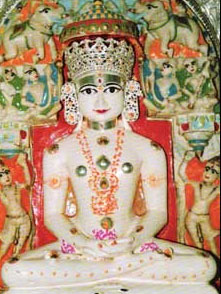
was the arrival of a Panchdhatu Jin Bimb of Shri 1008 Bhagwan Mahavir from
Kishangarh, Rajasthan. The image was initially installed in a room made
available in an office at the Bangkok Gems and Jewelry Tower in the Suriwong
area. This modest arrangement became the spiritual beginning of the organised
Digambar Jain presence in Bangkok. The community subsequently acquired a
permanent property at 143/3, Soi Putha Osoth, off Maha Set Road, Suriwong,
Bangkok. Contemporary reports record the transfer of ownership of the
three-storey townhouse to the Digambar Jain Foundation in July 2007, marking an
important milestone for the Jain community in Thailand.
Shri 1008 Mahaveer Digamber
Jain Mandir
The temple is generally
identified as:
Shri 1008 Mahaveer Digamber
Jain Mandir
143/3, Soi Putha Osoth, off Maha Set Road,
Near K. Building Apartment, Suriwong,
Bangkok – 10500, Thailand.
A Jain directory also records
the Jinalay telephone number as +66-2-2337894. The temple premises were
developed to meet both devotional and community requirements. Historical
descriptions state that the Jin Bimb and principal prayer hall were situated on
the second floor, while the upper floor provided space for Swadhyaya—study and
contemplation of Jain scriptures and philosophy. The Jinalay was subsequently
expanded into an adjoining property, providing a larger prayer hall for the
growing congregation. A 2015 account states that this expansion had taken place
in 2009.
Mulnayak and
Religious Significance
The Bangkok Digambar Jain
Mandir is particularly associated with the Jin Bimb of Shri 1008 Bhagwan
Mahavir, the twenty-fourth Tirthankara of the present Jain time cycle.
Community records describe the principal image as a Panchdhatu Jin Bimb brought
from India. The serene, unadorned form of the Digambar Jin image represents the
Jain ideals of Vitaragata—complete freedom from attachment and
aversion—renunciation, self-realisation and liberation. For devotees living
thousands of kilometres away from India's historic Jain centres, the presence
of a consecrated Jinalay in Bangkok provides an important spiritual connection
with their religious and cultural heritage.
Religious
Activities and Festivals
The Bangkok Jinalay has
developed into a centre for the observance of important Digambar Jain religious
occasions. Community accounts mention celebrations and religious activities
connected with: Das Lakshan Parva, Mahavir Janma Kalyanak, Mahavir Nirvana
Kalyanak, regular Puja, Swadhyaya, and religious education for children through
Pathshala activities. Through such observances, the temple enables Jain
families living in Thailand to remain connected with the philosophical and
ethical foundations of Jain Dharma.
Swadhyaya
and Education of the Younger Generation
One of the most valuable
functions of an overseas Jain temple is the preservation of religious knowledge
among succeeding generations. The provision of a dedicated Swadhyaya hall in
the Bangkok temple therefore has significance beyond its physical dimensions.
It provides an environment for studying Jain philosophy, discussing scriptures,
conducting religious discourses and introducing children to Jain principles. For
younger Jains born or brought up outside India, such institutions help them
understand the fundamental Jain teachings of Ahimsa, Anekantavada, Aparigraha,
Karma, self-discipline and compassion for all living beings. The temple
consequently performs a dual role: it preserves an ancient spiritual tradition
while enabling that tradition to remain meaningful in a modern international
environment.
Social and
Charitable Activities
The philosophy of Jainism
regards compassion and service as natural expressions of spiritual life. The
Bangkok Jain community has accordingly been associated with charitable and
humanitarian initiatives. Published community information mentions activities
such as Aahar Daan, Gau Daan, assistance to underprivileged children and
elderly persons, Ayurveda camps and blood-donation programmes. Such initiatives
extend the significance of the Jinalay beyond ritual worship. They embody the
Jain principle that religion should manifest itself through Karuna, Seva and
Ahimsa—compassion, service and non-violence.
Jain in Thailand
Another notable feature of
Jain life in Bangkok has been cooperation between the Digambar and Shwetambar
communities. Historical reports concerning the establishment of the Digambar
temple specifically acknowledge that members of both traditions follow the same
Tirthankaras and the fundamental philosophy of Jain Dharma and had jointly
observed important religious festivals. The creation of a separate Digambar Jinalay
arose principally from differences in the form of Jin images and methods of
worship rather than any rejection of the larger Jain fraternity. Bangkok therefore offers an interesting
example of how different Jain traditions can maintain their individual
religious practices while continuing to recognise their shared spiritual
heritage.
Jainism in
an International Setting
The importance of the Bangkok
Digambar Jain Tirth must also be understood in the wider context of the globalisation
of the Jain community. Historically, the great Jain pilgrimage centres—such as
Sammed Shikharji, Girnar, Shatrunjaya, Shravanabelagola, Sonagiri and many
others—developed in India. In modern times, however, Jain communities have
established temples and religious organisations across Asia, Europe, Africa,
North America and other regions.
The Bangkok Jinalay represents
this international dimension of Jain Dharma. It demonstrates how a relatively
small expatriate community can preserve its religious identity while
participating fully in the economic and social life of another country. The
temple is therefore more than an overseas place of worship. It is a symbol of
continuity—linking Jain families in Thailand with the ancient spiritual lineage
of the Tirthankaras.
Spiritual
Message
The deepest importance of the
Bangkok Digambar Jain Tirth lies not in the size of its building but in the
ideals for which it stands. In the middle of one of Asia's busiest and most
cosmopolitan cities, the Jinalay offers a space for silence, introspection and
spiritual discipline. The peaceful image of the Tirthankara reminds the devotee
that true happiness does not arise merely from material prosperity, but from conquest
over anger, pride, deceit, greed, attachment and desire.
Shri 1008 Mahaveer Digamber
Jain Mandir, Bangkok, represents an inspiring chapter in the international
journey of Jain Dharma. Created through the collective devotion and
determination of a relatively small Jain community, it has grown into an
important centre of Darshan, Puja, Swadhyaya, religious education, festival
observance and community service. For Digambar Jains residing in or visiting
Thailand, the Jinalay provides a spiritual home away from India. For the wider
Jain world, it demonstrates that geographical distance need never become a
barrier to preserving faith, philosophy and tradition.
Above all, the Bangkok
Digambar Jain Tirth carries to Southeast Asia the timeless message proclaimed
by the Tirthankaras: “Ahimsa Paramo Dharmah” Non-violence is the supreme
Dharma.
-----------------------------------------------------
Mail to : Ahimsa Foundation
www.jainsamaj.org
R21082026
Ahimsa Foundation warmly welcomes information, photographs, literature, articles, and other meaningful contributions for publication on this web portal: www.jainsamaj.org | ✉ CAINDIA@HOTMAIL.COM
We also invite advertisements and sponsorship support to help us expand the reach of this social initiative and promote public awareness of Jain ideology.
 Related
 Related
 Related

Copyright © 2026 jainsamaj. All rights reserved.