


Michchhami Dukkadam: Forgiveness, Paryushan and the Jain Journey Within

At the conclusion of Paryushan, perhaps the most familiar words heard among Jains are: “Michchhami Dukkadam.” Friends say them to friends,
children to parents, relatives to one another, and increasingly people send the
message to acquaintances across the world. The sentiment is profound: if,
knowingly or unknowingly, through thought, word or action, I have caused you
pain, may that wrongdoing become fruitless; please forgive me. During
Pratikraman too, we repeatedly encounter the expression Tassa Michchhami
Dukkadam while acknowledging transgressions and seeking to free ourselves
from the karmic consequences of wrongful conduct.
But there is a danger in
repeating even the most beautiful words year after year: a spiritual
practice can gradually become a social custom, and a social custom can become
mechanical. The real challenge of Michchhami Dukkadam is therefore not
simply to say it, but to live it.
From Asking
Forgiveness to Giving Forgiveness
The extraordinary depth of
Jain thought on forgiveness becomes apparent in the familiar sentiment:
Khamemi Savva Jiva — I forgive
all living beings.
It is followed by the
complementary aspiration that all living beings may forgive us, that we have
friendship towards all and enmity towards none. Notice the order of thought. We
are not concerned only with obtaining forgiveness. We begin by forgiving.
This distinction is important.
We sometimes hear someone say, “I am perfectly willing to forgive him. Let him
first come and apologise.” But is that really forgiveness? Such forgiveness
remains conditional upon the conduct of the other person. It may even become a
subtle expression of ego: Let the person first admit that I was right and he
was wrong; then I shall magnanimously forgive him.
True forgiveness asks
something more difficult of us. It asks us to release anger even when the other
person has not apologised. We do not forgive because the offender deserves our
forgiveness. We forgive because we deserve freedom from the anger,
resentment and hostility that the injury has left within us. Forgiveness
does not mean approving wrongdoing. It does not require forgetting what
happened. Nor does it require restoring a harmful relationship or allowing
someone repeatedly to hurt us. It means refusing to let yesterday's wound continue
controlling today's consciousness. There is a penalty for refusing to forgive.
The offender may continue with life completely unaware of our anger, while we
carry the injury within ourselves. Resentment then becomes a burden borne not
by the person we resent, but by us. This is why the Jain understanding of kshama
is so much more profound than social reconciliation. Forgiveness is an
instrument of inner purification.
Paryushan: A
Festival Directed Inward
Paryushan is sometimes called
the king of Jain festivals, but it differs fundamentally from festivals centred
on external celebration. Its real field of activity is the self. It is a period
of fasting, restraint, introspection, scriptural study, repentance, meditation
and renewed awareness of ahimsa. Monks and nuns traditionally remain in
one place during the rainy-season Chaturmas, giving lay communities
greater opportunities for religious instruction and reflection.
Food is restricted, but
Paryushan asks us to restrain much more than food.
Can we fast from anger?
Can we abstain from gossip?
Can we reduce pride?
Can we stop feeding resentment?
Can we control the desire to retaliate when somebody
hurts us?
Can we practise ahimsa not merely through what we
eat but through what we think, say and do?
Without this inner dimension,
even severe austerity risks becoming another achievement of the ego. The Jain
traditions approach this period in somewhat different ways, but these
differences are best understood as different paths towards the same
destination.
The
Śvetāmbara Tradition: Paryushan and Samvatsari
Among Śvetāmbara Jains,
Paryushan is traditionally observed for eight days. The period places
considerable emphasis on Pratikraman, fasting, religious discourses, meditation
and scriptural study, particularly the Kalpa Sutra, which includes
accounts connected with the Tirthankaras and especially Bhagwan Mahavira. Different
Śvetāmbara communities and individuals observe different levels of austerity.
Some undertake an upvas, while others undertake longer fasts such as Attham
or Atthai. Some practise Ayambil, involving a deliberately
austere meal with substantial restrictions on ingredients and taste. Dietary
restraint and avoidance of foods regarded as involving greater harm to living
organisms are also emphasised. But fasting is meant to serve spiritual
purification rather than become an end in itself. The culmination is Samvatsari,
the great annual occasion for introspection, repentance and forgiveness.
The extended Samvatsari
Pratikraman requires the individual to look back upon conduct and recognise
transgressions committed knowingly or unknowingly. Afterwards, Jains seek
forgiveness from family members, friends, acquaintances and others.
Hence the familiar:
Michchhami Dukkadam.
Yet its deepest meaning is
universal. Forgiveness is not intended to stop at the boundaries of family,
community or even humanity. Jain ethics extends the attitude of non-enmity
towards all living beings.
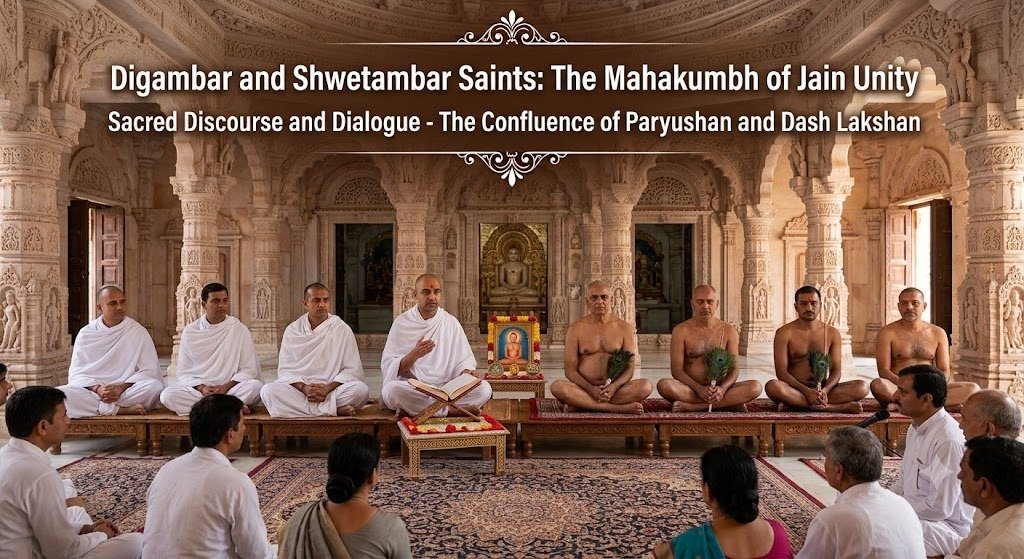
The
Digambara Tradition: Das Lakshana Parva
The Digambara tradition
organises this spiritual season somewhat differently. Its major observance is
generally known as Das Lakshana Parva, extending over ten days.
Instead of building the
observance around exactly the same structure as Śvetāmbara Paryushan, each day
focuses attention on one of the ten supreme virtues:
The sequence itself contains a
beautiful lesson. It begins with Kshama—forgiveness. Before truth, austerity,
renunciation and non-possessiveness comes the attempt to overcome anger. Digambara
devotees may undertake fasting and other austerities, attend temple worship and
religious discourses, study Jain scriptures and contemplate the virtue assigned
to each day. Study of texts such as the Tattvartha Sutra is also
associated with Das Lakshana observance. The period culminates around Ananta
Chaturdashi, followed by the observance of Kshamavani, the special occasion for
seeking and granting forgiveness. The expression Uttam Kshama is particularly
associated with the Digambara tradition, although the wider language and
practice of seeking forgiveness increasingly crosses community boundaries. Thus
Samvatsari and Kshamavani differ in their liturgical and calendrical contexts,
but they converge upon essentially the same spiritual demand: remove enmity
from the heart.
Different
Traditions, One Spiritual Objective
Within the broad Śvetāmbara
tradition itself are different communities and monastic traditions, including
Murtipujak, Sthanakvasi and Terapanth traditions. Their forms of worship and
emphasis can differ. Image-worshipping communities may centre more activities
around derasar worship and associated rituals, while non-image-worshipping
traditions give greater emphasis to prayer, meditation, Pratikraman, scriptural
study and discourses. These distinctions are meaningful, but they should not
obscure what is common. Across Jain traditions, Paryushan and Das Lakshana call
the individual towards self-examination, restraint, repentance, non-violence
and purification of consciousness. The question is not whether my ritual is
identical to yours. The question is whether the ritual is changing me.
Fasting Is
Not Only About Food
Paryushan is closely
associated with tapa, and some extraordinary fasts are undertaken during
this period. But the deeper purpose of fasting is not physical deprivation. Giving
up food while continuing to consume anger, jealousy, pride and resentment
defeats the larger purpose. A person may remain without food for several days
but remain unable to forgive an insult from several years ago. Which is the
more difficult fast? Perhaps Paryushan invites us to practise another kind of upvas:
distancing ourselves from anger, greed, deceit and ego, and moving closer to
the true nature of the soul. Similarly, Pratikraman should not become
merely the recitation of words. The very idea involves turning back—examining
where we have departed from right conduct and resolving to correct ourselves. That
requires honesty.
Prayaschitta:
When We Are the Ones Who Caused Hurt
Forgiveness has another side. Sometimes we are not the
injured party. We are the offender.
In such cases, merely forwarding “Michchhami Dukkadam” to
hundreds of contacts cannot substitute for genuine recognition of what we have
done. Jainism gives great importance to repentance and Prayaschitta. If
I recognise that my words have humiliated somebody, that my actions have harmed
someone, or that my ego has damaged a relationship, the first transformation
must occur within me. Where appropriate, an apology can be deeply healing. But
the foundation must be genuine repentance and a determination not to repeat the
behaviour.
Otherwise Michchhami Dukkadam risks becoming an annual
resetting of accounts while we continue committing the same offences.
Forgiveness
Does Not Mean Weakness
One reason people resist forgiveness is fear.
“If I forgive him, he will think what he did was
acceptable.”
“If I forgive her, she will do it again.”
But forgiveness and accountability are different things.
We can forgive a person and still establish boundaries.
We can forgive and still say, “What happened was wrong.”
We can forgive without restoring the same degree of
trust.
We can forgive while protecting ourselves from repeated
harm.
Forgiveness deals with the poison within us. Justice and
prudence deal with the external situation. The two need not be confused.
The Most
Difficult Forgiveness
It is easy to send Michchhami Dukkadam to those whom we
love and who have hardly offended us.
The real spiritual test is different.
Can I mentally say it to the relative with whom I have
not spoken for years?
To the business associate whom I believe cheated me?
To the friend who betrayed my confidence?
To the person whose words humiliated me?
Perhaps we cannot immediately restore every relationship.
Perhaps some wounds require time. But we can at least begin the inner process
of refusing to nourish hatred.
That may be the real beginning of Kshama.
Forgiving
Ourselves
There is one more person whom
we sometimes forget to forgive: ourselves. Repentance is necessary, but endless
self-condemnation is not spiritual progress. If we have genuinely recognised a
mistake, made amends where possible, undertaken Prayaschitta and
resolved to change, we must eventually stop punishing ourselves. Otherwise
remorse itself can become another form of attachment. The purpose of repentance
is transformation, not permanent guilt.
Bringing
Michchhami Dukkadam into Daily Life
Why should this magnificent practice be confined to one
day each year?
Imagine practising a small Samvatsari every night.
Before sleeping, ask:
Whom did I hurt today?
Who hurt me?
What anger am I carrying?
What did my ego make me say?
Is there somebody I need to forgive?
Is there somebody from whom I should seek forgiveness?
If this became a daily practice, we would arrive at
Paryushan carrying considerably less emotional baggage.
Then Michchhami Dukkadam would cease to be merely an
annual greeting.
It would become a way of living.
The deepest lesson common to
Paryushan, Samvatsari, Das Lakshana and Kshamavani is therefore beautifully
simple. Religion cannot remain confined to temples, scriptures, fasting or
rituals. Those practices become meaningful when they transform our relationship
with other living beings. Forgiveness makes us lighter. It loosens anger,
weakens ego and interrupts the cycle in which hurt produces retaliation and
retaliation produces further hurt. I have personally discovered that denying
hurt does not make it disappear. Unacknowledged wounds can turn quietly into
resentment. Learning to forgive does not erase the past, but it prevents the
past from continuing to rule the present. That is why I like the thought that
forgiveness is not primarily about letting another person escape punishment; it
is about removing the knife from our own soul. So this Paryushan, let us fast
if we can. Let us perform Pratikraman. Let us study the scriptures, practise samayik,
undertake tapa, listen to discourses and observe the traditions handed
down to us. But alongside all these, let us undertake perhaps the hardest
austerity of all:
Let us give up an old
resentment.
Let us forgive somebody who has never asked to be
forgiven.
Let us apologise where we know we have caused pain.
Let us replace hostility with maitri—friendship
towards all.
And when we finally say Michchhami
Dukkadam, let those words arise not merely from our lips, but from a heart that
has genuinely become lighter.
Khamemi Savva Jiva.
Savve Jiva Khamantu Me. Mitti Me
Savva Bhuesu.
Veram Majjham Na Kenai.
May I forgive all living
beings.
May all living beings forgive me.
May I have friendship with all.
May I have enmity towards none.
That is the true celebration of forgiveness. That is the
spirit of Paryushan. And perhaps that is the real meaning of Michchhami
Dukkadam.
Mail to : Ahimsa Foundation
www.jainsamaj.org
R130926
Ahimsa Foundation warmly welcomes information, photographs, literature, articles, and other meaningful contributions for publication on this web portal: www.jainsamaj.org | ✉ CAINDIA@HOTMAIL.COM
We also invite advertisements and sponsorship support to help us expand the reach of this social initiative and promote public awareness of Jain ideology.
 Related
 Related
 Related

Copyright © 2026 jainsamaj. All rights reserved.