


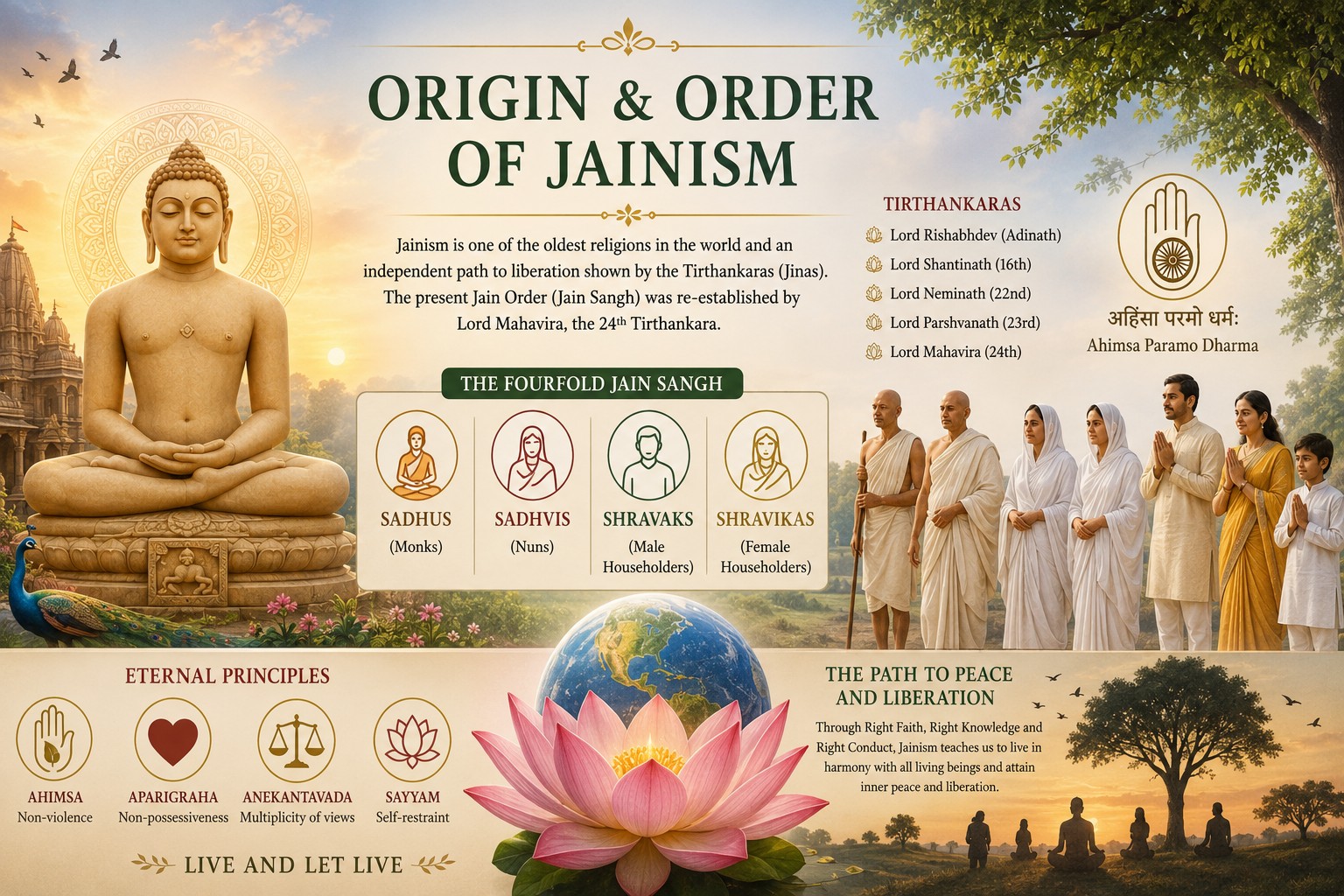
Jainism is one of the oldest religions in the world. It has also been known by various names such as Shraman Dharma and Nirgrantha Dharma. Jainism is not an offshoot of any other religion; rather, it is an independent and ancient spiritual tradition that has been recognized by different names during different historical periods.
The religion was propagated by the Tirthankaras, also known as Jinas. A follower of a Jina is called a Jain, and the religion practiced by them is known as Jainism. Each Tirthankara revitalizes and re-establishes the Jain order, known as the Jain Sangh. The present Jain Sangh was re-established by Lord Mahavira, the 24th and last Tirthankara of the current time cycle.
The Jain Sangh consists of four sections:
Sadhus (Monks)
Sadhvis (Nuns)
Shravaks (Male householders)
Shravikas (Female householders)
The first Tirthankara of the present era was Lord Rishabhdev, also known as Adinath. Other prominent Tirthankaras include Lord Shantinath (16th Tirthankara), Lord Neminath (22nd Tirthankara), Lord Parshvanath (23rd Tirthankara), and Lord Mahavira (24th Tirthankara), who remains the most revered and influential Tirthankara of the present age.
Lord Mahavira attained Nirvana (liberation from worldly existence) in 527 B.C. He had eleven principal disciples known as Ganadharas. During Lord Mahavira’s lifetime, nine Ganadharas attained liberation, while Gautam Swami and Sudharma Swami survived him. Gautam Swami attained omniscience and became an Arihant on the very night of Lord Mahavira’s Nirvana. Sudharma Swami later achieved the same state. Jambu Swami, the disciple of Sudharma Swami, became the last Arihant of the present time cycle. After him, no one attained omniscience, and spiritual knowledge gradually declined over time.
The teachings of Lord Mahavira were preserved by his Ganadharas in the form of scriptures known as the Agamas. These scriptures were compiled into twelve sections called the Dwadashangi (Twelve Angas). Initially, these teachings were transmitted orally, as Jain monks memorized and recited them rather than writing them down.
Approximately 150 years after Lord Mahavira’s Nirvana, a severe famine lasting twelve years struck the region. During this period, Acharya Bhadrabahu and a group of monks migrated to South India. After the famine ended, some monks returned to North India and discovered inconsistencies in the oral transmission of the scriptures among different groups of monks. To preserve the teachings accurately, the first Jain council was convened at Pataliputra around 160 years after Lord Mahavira’s Nirvana.
Acharya Bhadrabahu, who possessed complete knowledge of all twelve Angas, could not attend the council. As a result, the monks present were able to compile only the first eleven Angas, while the twelfth Anga was eventually lost. The monks who had migrated to the South did not accept this compilation, leading to the first major division within Jainism.
Thus, Jainism came to be divided into two principal sects:
Digambara
Shvetambara
The Shvetambara monks wore white robes, whereas the Digambara monks practiced complete renunciation by not wearing clothes.
AHIMSA FOUNDATION INDIA
R070526
 Related
 Related
 Related
